- Home
- Blog Articles
- Seine River in Paris: Map, Facts & Where to Board a Cruise
- 24 October 2026
- General
The river that flows through Paris is the Seine. It curves through the city from east to west and appears in almost every view you will want to photograph. If you are looking for a quick map of the Seine River in Paris, the key facts or the best place to step on a boat, this guide answers all three in a few minutes.
Which river flows through Paris?
The river that flows through Paris is the Seine. It rises in Burgundy, travels about 777 km across northern France and reaches the English Channel near Le Havre. Only around 13 km of that journey run through the capital, but it is the stretch everyone remembers: the Eiffel Tower, Notre-Dame, the Louvre and the Musée d'Orsay all stand on or beside the water. If you are wondering which river the Eiffel Tower is on, it is the Seine, on the Left Bank.
The Seine in Paris: a map in words
Picture the river as a curve across the city. It enters from the east, leaves to the west and divides Paris into two halves: the Right Bank (Rive Droite) to the north and the Left Bank (Rive Gauche) to the south. Two natural islands sit in the middle, the Île de la Cité and the Île Saint-Louis. Travelling from east to west, you will roughly meet:
- The Île Saint-Louis and the Île de la Cité, the historic heart of the city, where Notre-Dame cathedral stands
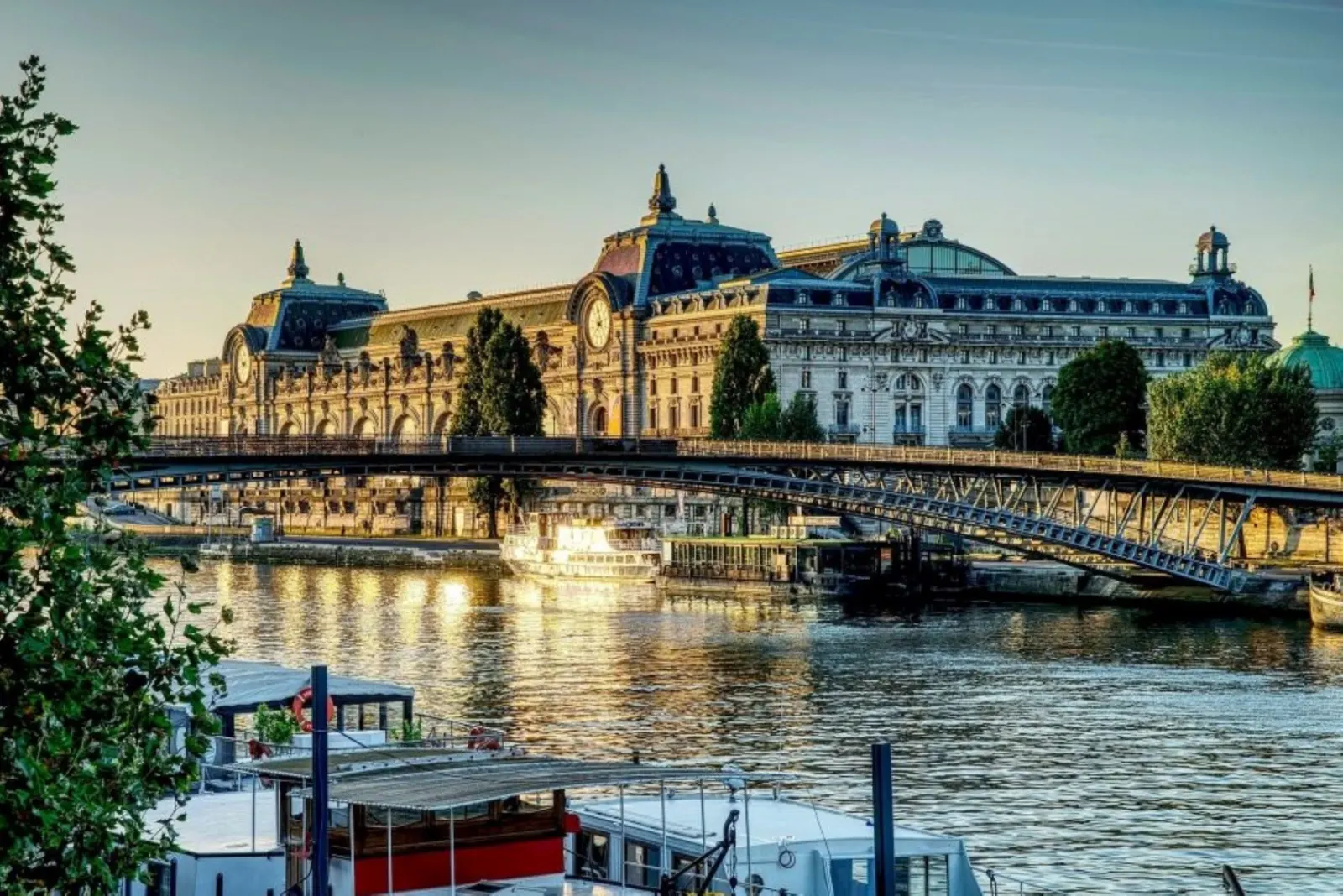
- The Louvre on the Right Bank and the Musée d'Orsay on the Left Bank, almost facing each other across the water
- The Pont Alexandre III, one of the best-known bridges in Paris
- The Eiffel Tower on the Left Bank, near the western end of the central stretch
Seine River facts at a glance
- Length: about 777 km, of which roughly 13 km are in Paris
- Source: Source-Seine in the Côte-d'Or (Burgundy); mouth: the English Channel near Le Havre and Honfleur
- Bridges: 37 in Paris; the Pont Neuf, completed in 1607, is the oldest surviving bridge over the Seine in Paris, despite its name ("New Bridge")
- UNESCO: the banks of the Seine between the Pont de Sully and the Pont d'Iéna have been a World Heritage Site since 1991
- The name: thought to come from Sequana, a Celtic goddess of the river
- Pronunciation: in French it sounds close to "sen"; English speakers often say "sayn"
Can you swim in the Seine?
Swimming in the Seine was banned from 1923 and stayed that way for about a century. Since the summer of 2025, the City of Paris has opened a few free, supervised bathing sites during the summer season; outside those designated areas, swimming is still not allowed. Opening dates, age limits and daily closures for water quality change, so check the official City of Paris website before you plan a swim. If you would rather enjoy the river without getting wet, a cruise is the easiest way.
Where do Seine cruises leave from?
Sightseeing boats depart from several piers along the river, many of them close to the Eiffel Tower and in the city centre. The 1-hour Bateaux Parisiens cruise leaves from Port de la Bourdonnais, right at the foot of the Eiffel Tower. You can book it here: Paris 1-hour Seine River sightseeing cruise tickets. For boarding details, see our Seine River cruise tickets guide.
Which Seine cruise should you choose?
- Short on time: the 1-hour Seine River cruise
- Paris by lights: Seine River night cruise tickets and our night cruise guide
- A little treat: the cruise with a drink, ice cream or dessert or the French crêpe tasting cruise
- Museum and river: Louvre Museum ticket with Seine River cruise or Orsay Museum with Seine River cruise
Not sure yet? Our article Which Seine River cruise should you choose? compares every option side by side.
Frequently asked questions
Which river flows through Paris?
The Seine. It separates the Right Bank in the north from the Left Bank in the south.
Which river is the Eiffel Tower on?
The Seine, on the Left Bank, next to the Pont d'Iéna.
How long is the Seine in Paris?
The river is about 777 km long in total; the stretch that runs through Paris is about 13 km.
Where does the Seine start and end?
It rises at Source-Seine in Burgundy and flows into the English Channel near Le Havre and Honfleur.
Where can I read about the history of the Seine?
We tell the story of how the river shaped the capital in The Seine River and the History of Paris.